Differentiating Instruction for Golf StudentsThis post is primarily for instructors teaching golfers with disabilities but in reality the same concepts apply to teaching able bodied golfers. Being a good instructor probably has more to do with our "human-to-human skills" than it has to do with swing knowledge only. Don't get me wrong, we have to be technically competent, when we speak we need to know what we are talking about, but if we are without "relationship skills", all of our technical expertise will just be for our own amusement.
For the Instructor, the “What to Do”Person FirstInstead of: person confined to a wheelchair. Say: a person who uses a wheelchair.
Instead of: handicapped or disabled. Say: a person with a disability. etc.
Disability - Anything that deviates from perfect. Torn
rotator, slipped disc, ingrown toe nail removed, uneven leg length; decreased muscle control, strength, endurance; balance issues;
CP, MS, SB, VI
Awareness of the Student’s Ability and DisabilitySize, strength, athletic/physical ability, technical skills. No two golfers are identical. There are different instructional approaches for each student’s functional profile / level of performance.
What is the student’s level of performance?
What general modifications must the instructor make?
What are the students overall goals for golf?
What do they want to learn today?
How did they learn to play?
What does the student think when swinging/playing?
What is the student trying to do?
Functional Profile / Level of Performance,
Inclusion Through Sports by Dr. Ron Davis, Texas
Womens University,
Denton, Texas
Low – multiple impairments, limited physical ability and strength
Moderate – some impairments, moderate physical ability and strength
High – few impairments, able body physical ability and strength with what they have
Any one medical condition can present from “low” to “high”.
General Modifications for Performance Levels
(Suggestions Only, ALWAYS EXPERIMENT)
Lowequipment - grip aids, adaptive gloves, club modifications, play from chair
skills – small swings, putting, chipping, use only 1 or 2 clubs
Moderateequipment – few grip aids, some club modifications, probably play from
SRGC (single rider golf cart)
skills – increase size of shots, use different clubs
Highequipment – a few club modifications,
SRGCskills – same as able body golfer
Instructing/Coaching/TeachingScience: a system of knowledge covering general truths or general laws especially as obtained and tested through scientific method, i.e., if you do this, this will happen. system or method [or concept] reconciling practical ends with scientific laws (Webster) "A body persists in a state of rest or of uniform motion unless acted upon by an external force." “To every action there is an equal and opposite reaction."
Isaac Newton
Relational Coaching: the informed, conscious, common sense, practical application and communication of the science. Characterized by caring, interest, communication, empathy, listening, questions, understanding, unconditional acceptance, know no boundaries/limits. Expect different expectations, i.e., learning experience and recreation vs scoring.
According to,
Relational Coaching: Journeys Towards Mastering One-to-One Learning, by Erik
de Haan: “The research shows that the questions that most preoccupy professional coaches are these:
What works best for this [student….]?
Which method, which approach, […….] can I use in order to help this [student]?
What will help […] in this session, at this moment?
The main question for coaches is therefore:
‘Which, of the whole range of things I can do now, is best for my [student]?’”
Of all the things that can be done, prioritize and work on the thing with the highest priority. And it probably won’t be "
Step 1" of a “
6 Steps to Lower Scores” method, for example. It is not about you, the instructor, covering the grip, stance and posture, etc., it is about the student. No two golfers are identical. Preconceived notions
aren’t relational. And there in lies the art of teaching and coaching.
Art: a skill acquired by study, training, observation; the conscious use of creative imagination, implies a personal,
unanalyzable creative power, suggests ingenuity and subtlety in devising, inventing, or executing, [The bridge between the science and coaching the student. Communicating the science effectively.] (Webster).
 Ernest Jones
Golfers with disabilities know no boundaries:
Butch Lumpkin video Tim Caldwell videoAmputee Golf Association videoWhy tell students how? They know how…tell them
what to do….tell them by asking.
Ask questions. It is more engaging and revealing for students and instructors. Asking questions is relational coaching. Studies from psychologists reveal that our learning is influenced by: 80% nonverbal ques, 17% voice (tone, pitch, timber, volume) and 7% the message.
Every student’s swing and body is uniquely theirs, like a fingerprint or signature. Instructors must be aware of “things” the way they are. Awareness is curative for the instructor and the student.
Body-focused instruction is problematic [especially for golfers with disabilities] because: no two golfers' bodies are exactly alike, it asks golfers to consciously control body motions that are by their nature unconsciously controlled, it asks the golfer to address too many things during the 2.5 seconds required for a golf swing, and demands that all body motions be correct in order to achieve the desired result.
Club-focused instruction by contrast, teaches: how the club moves for an effective swing, the club's movement is universal for every player and every club, and a lesson simple enough to accomplish during those same 2.5 seconds.
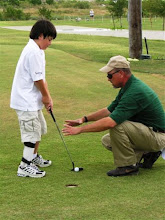
Manuel de la TorreGolf class example – What everyone is doing may be the same but how they do it is different and it will look different from student to student because no two golfers have the same size, strength, athletic/physical ability or technical skills.
For the Student, the “What to Do”
Deliberate Practice – specific activity, designed to improve performance. Students must practice and they must practice
what it is they know to do. Outliers by Malcolm Gladwell and Talent is Overrated by Geoff Colvin. See also Swinging Into Golf by Ernest Jones and Innis Brown.






 Posts

